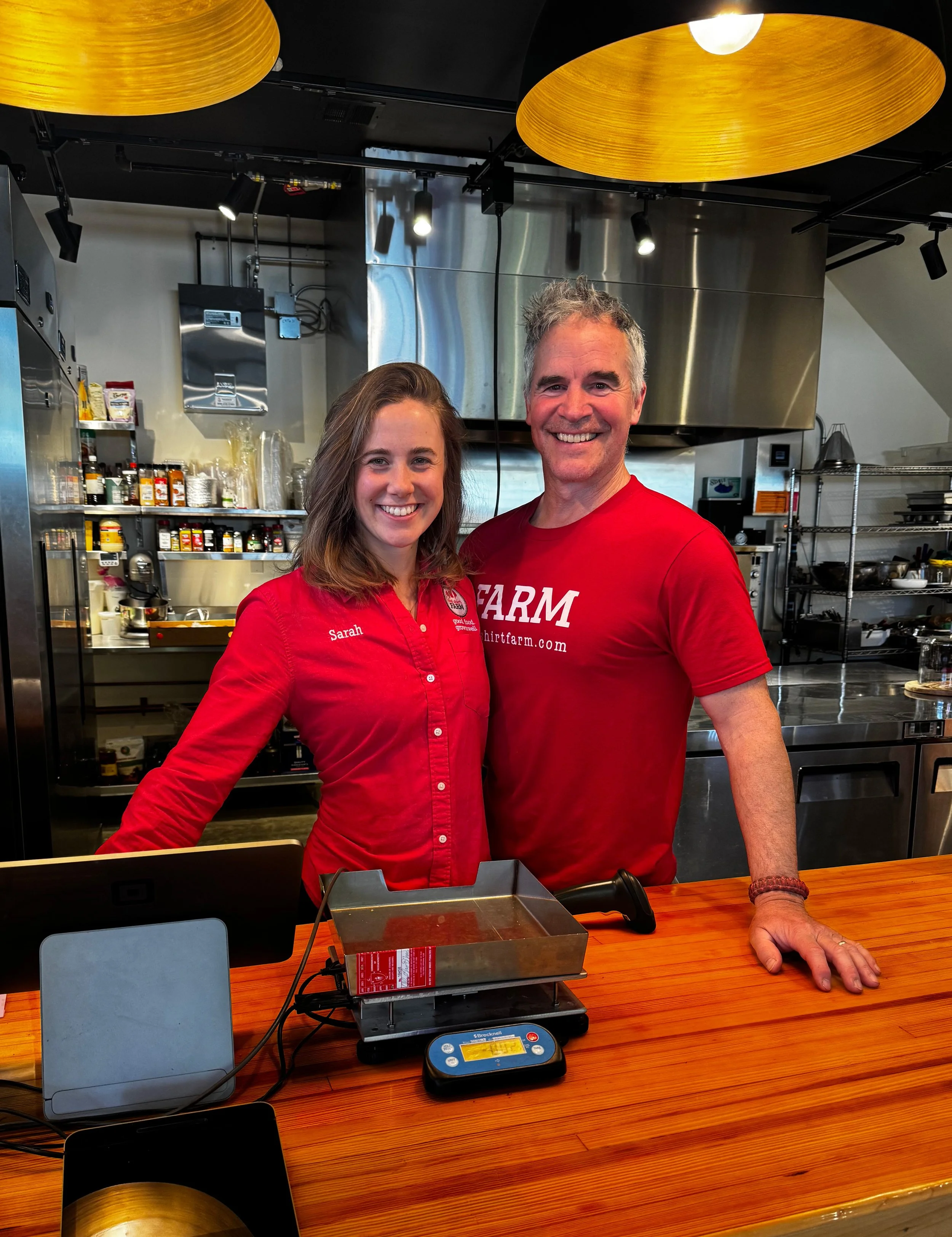
Jim and Sarah behind the counter, two of the team that keeps this place running.
Tuesday afternoon, the parking lot had two cars in it. In July it would have had ten. Nothing was wrong. The tourists who fill up Route 7 all summer went back to wherever they came from, and the kids went back to school.
What people don’t see is what it actually takes to keep the shelves the way they expect them, all year, not just in the busy months. Balancing what’s coming off our own fields against what we have to buy in from elsewhere. Making sure we never run out of something as basic as milk. Watching the prepared food case and trying to guess what people will actually want that week, not what we happened to make. None of it runs itself.
Most of what’s on these shelves came off our own fields, not a truck, and that comes with its own costs nobody sees from the parking lot: propane and electricity to heat the greenhouses, starting right about now and running straight through to spring, our second-biggest cost after labor. What we buy in isn’t getting any cheaper either. Wholesale prices and delivery charges creep up on almost everything, and that either gets absorbed or it shows up on the shelf price. There’s no third option.
Right now we pay our crew between eighteen and twenty dollars an hour, and we’d like to get closer to twenty-five, a real living wage in Berkshire County, as soon as we can afford to. Sarah and I pay everyone else first.
None of that is your problem to carry. It’s just what it takes to keep offering something most people can’t get anywhere else on Route 7: vegetables picked the day they’re sold, grown without the chemicals a bigger operation depends on, in a store that’s open year-round.
Even with all that, this year we’re doing better than last, something like ten percent ahead at this point in the season. That’s real, and we’re grateful for it. A business not yet two years old can be growing and still feel every slow Tuesday at the same time.
Every dollar spent here this fall does more than it would in July. It’s not a big ask, just a small one, repeated: the next time you’re deciding where to pick up milk, or bread, or a bag of onions, think of us first. That choice, multiplied by a lot of people making it a lot of Tuesdays in a row, is most of what gets a young farm through its second winter.
That’s also the idea behind our CSA, which opens for renewal the first week of October. When the first ones started decades ago, not far from here, the idea wasn’t to get people cheaper vegetables. It was to give a farm enough certainty at the start of a season that it could actually make it to the end of one. That’s still what it does. We’ll walk through how it works for anyone new to the idea when renewal opens. For now, just know it’s coming, and it matters more this year than most.
Sarah and I are expecting our first child in January, right in the middle of our slowest months. Sarah will be stepping back from the farm side come spring, which means figuring out who’s running the register and who’s running the fields at the same time we’re adjusting to a newborn. We’ve gotten through lean winters before, just the two of us. This time we’re doing it while building a family, and figuring out how to keep doing both at once.
We wouldn’t be a year into this without the people who keep showing up, especially on the quiet Tuesdays, when there’s no crowd and no reason to stop in except that you wanted to.
Thank you for helping keep this place standing.
The farm store is open year-round, and a CSA account is one way to shop with us through the slow months. More from the farm is in Field Notes.