
Nobody Ordered These Bees
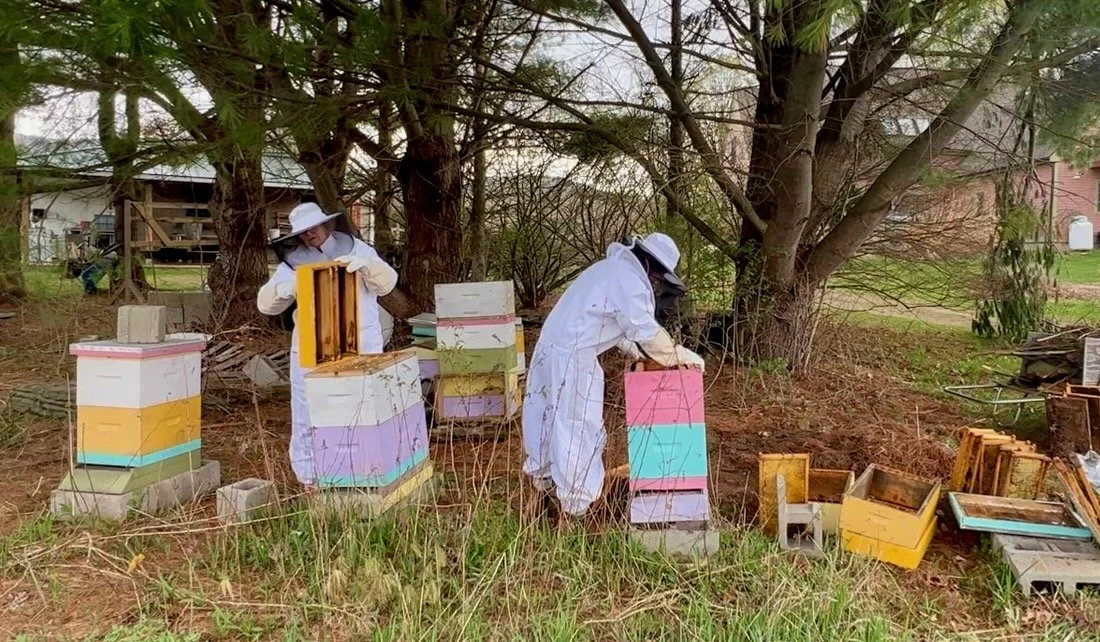
Sarah and her Mom, Kim, working on our hives.
A kamikaze bee stung me right in the forehead, guarding honey I had no interest in taking. That’s normal this time of year. Once the flowers dry up, a hive has real stores built up and not much coming in to replace them, and the bees get a lot less patient with anything near their hive, us included.
It’s a different story back in early spring, when there was no honey in either hive to defend, because there were no bees in them at all. I went out to check on the hives the way I always do first: crack the top, look for movement, don’t disturb much more than that. Nothing. I told myself it was still too cold, that they were dormant, that it was too early to worry.
A few weeks later I went back to look for real. Both hives were dead.
We hadn’t ordered new bees, and by then it was already too late in the year to get any. I figured we’d just go without, this year.
A couple of weeks later, with no warning, I saw movement in one of the hives again. Wild bees had moved in on their own, into the same box where the old colony had died. Not long after, part of that new colony swarmed and set up in the second hive too. By early summer we had two hives full of bees again, and we hadn’t ordered them, caught them, or done anything to invite them in.
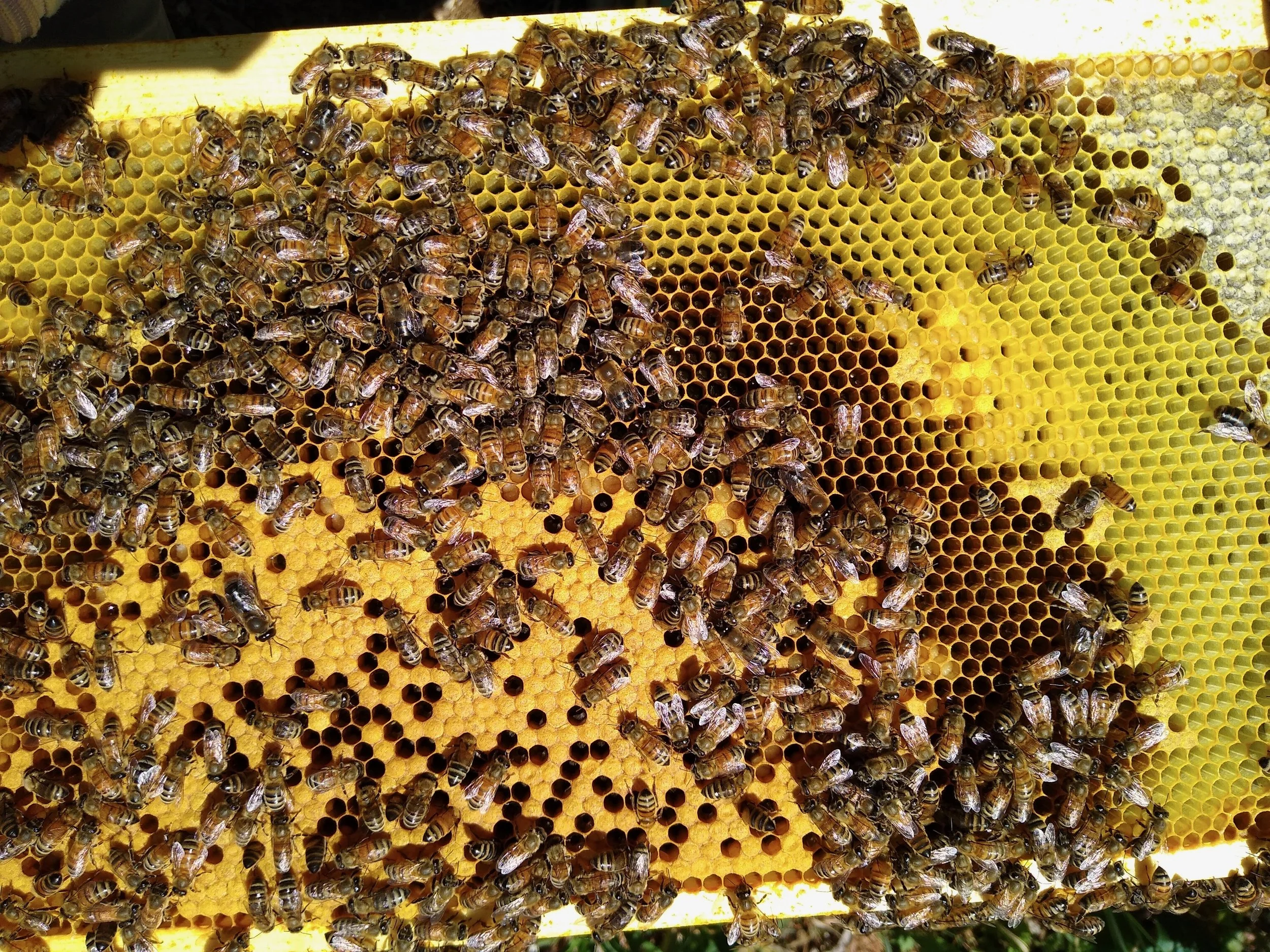
A frame from one of our hives showing workers engaged in a variety of tasks. In the lower left they are tending to brood cells. In the upper right you’ll see capped honey. Every hexagonal cell is made by the bees themselves who secrete wax from their abdomens and chew it into shape.
We don’t know for certain why our own bees didn’t make it and these did. But colonies that survive a winter with no one managing them tend to be tougher than what shows up in a box from a catalog. It’s possible we’ve got better bees now than we started with. We’ll find out.
A hive up close is more astonishing than most people ever get to see. Every worker is female. The only males are drones, whose one job is to mate with the queen. They don’t forage or make honey, and by fall, when a hive is living off what it’s stored and can’t feed anyone who isn’t working, the workers push them out. A worker spends her life moving through jobs by age instead: cleaning, then nursing the young, then guarding their hive, and only in her last weeks does she leave the hive at all to forage.
When we open a hive to check on it, one of the things we look for is the queen. She’s the largest bee in the box, with a heavy abdomen, but she isn’t always easy to find. The giveaway is usually a knot of workers moving together across the comb: her ladies in waiting, tending to her without pause.
The queen does one thing: she lays up to two thousand eggs a day, more than her own body weight in eggs, every day of the season.
Feed a fertilized egg royal jelly instead of ordinary food, and it grows into a queen. Feed the identical egg anything else, and it becomes a worker.
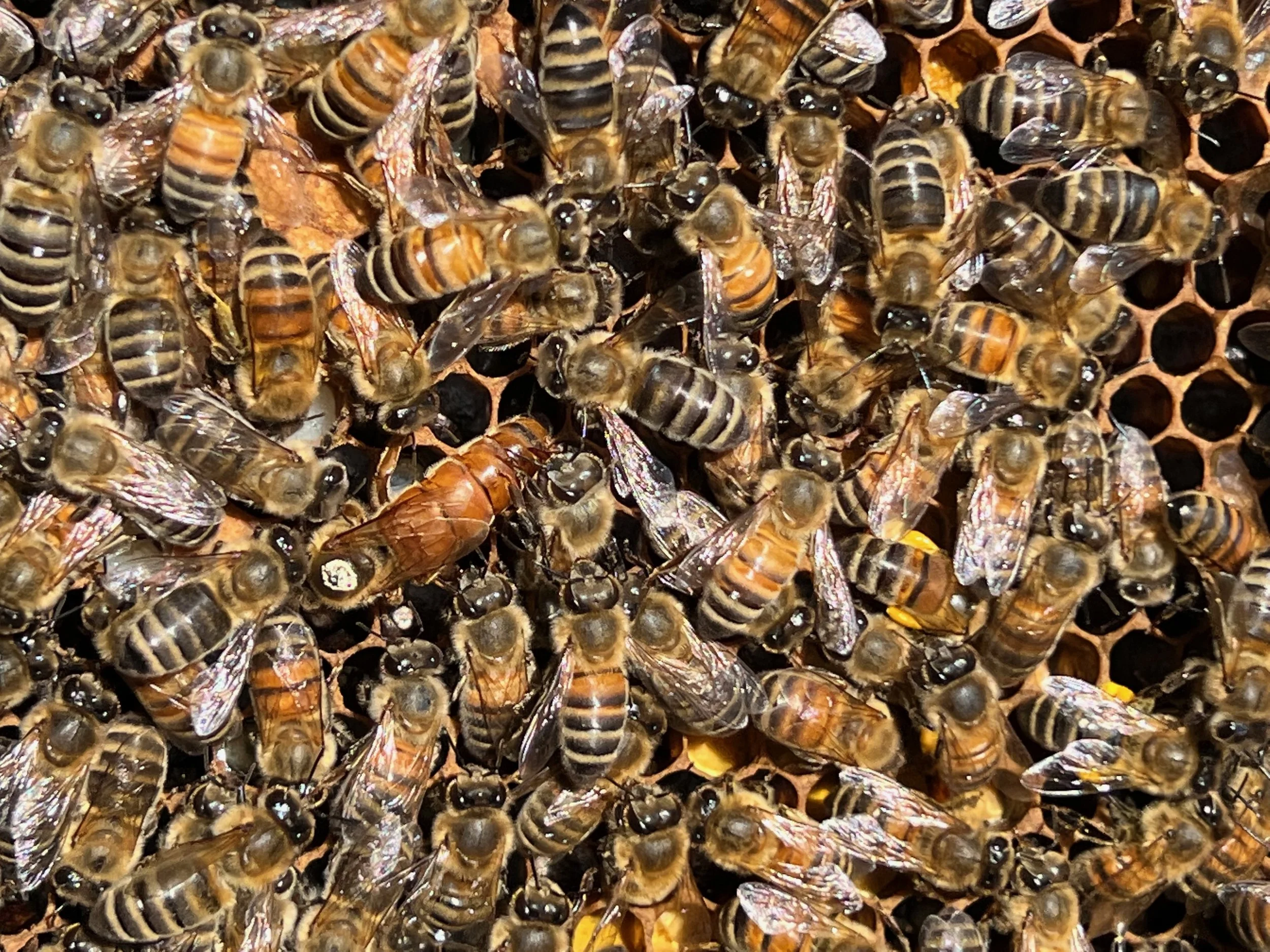
The queen laying eggs in open cells surrounded by her entourage. She’s the largest bee in the frame just to the left of center with a white dot on her thorax.
A forager who finds a good source of nectar comes home and dances on the comb, a figure eight angled a certain way, and it tells every bee watching which direction to fly and how far, precise enough that another bee can find a flower patch she’s never seen herself.
On a hot day I’ll find a “beard” of bees hanging outside the hive, and if I get close I can watch the whole cluster fanning its wings, moving air through the hive to cool it down.
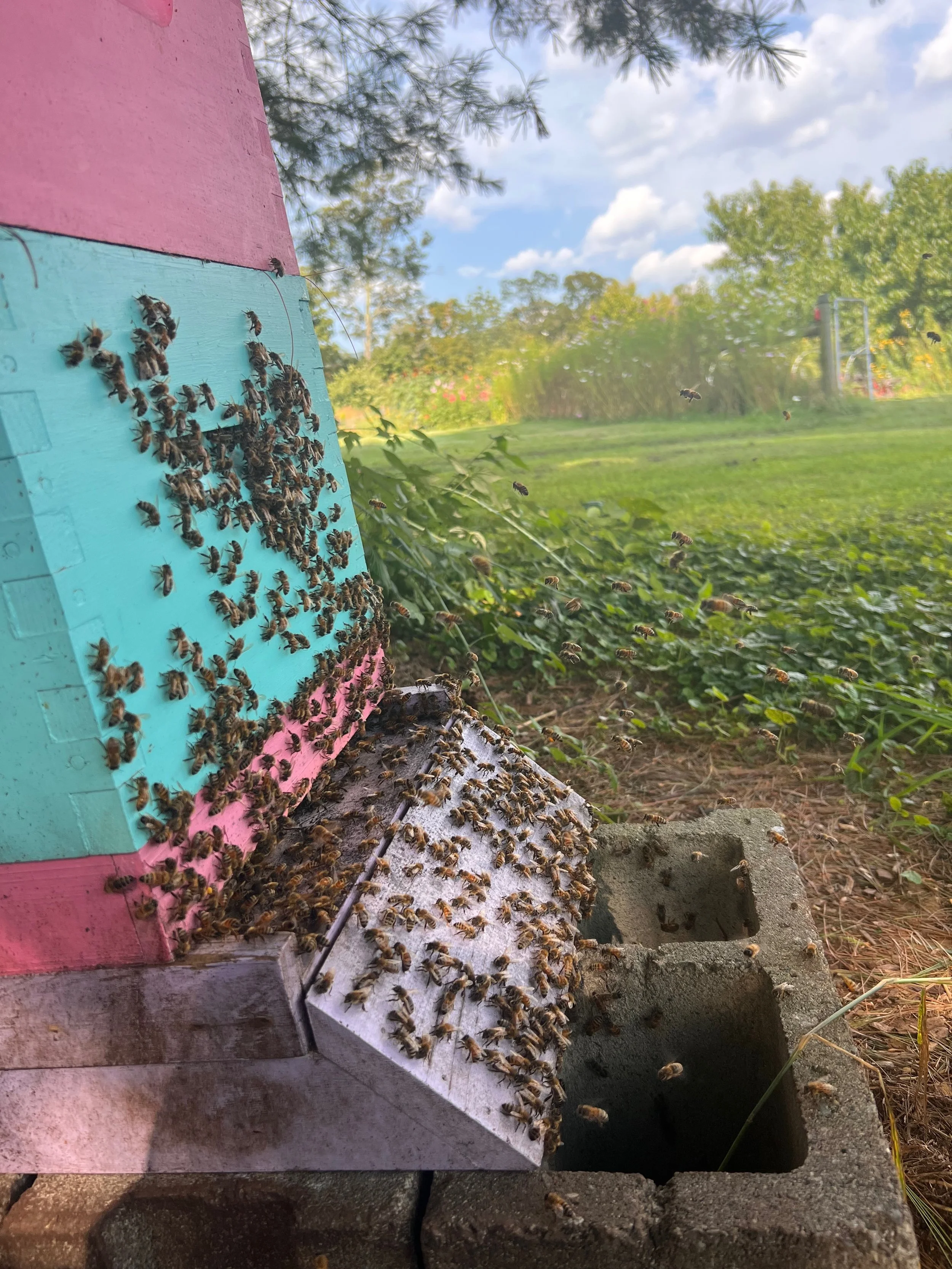
Bees crowded at the hive entrance fanning their wings to cool the hive.
Then there’s the honey. A forager carries nectar home in a stomach built just for the trip, passes it mouth to mouth to another bee who starts breaking the sugar down, and together they pack it into a cell and fan it dry before sealing it with wax. What’s left is about as close to eternal as food gets. Sealed pots of it have turned up in three-thousand-year-old Egyptian tombs, still good to eat.
A worker bee lives about five or six weeks in the height of summer, and spends nearly all of it foraging, flying so many miles that her wings wear ragged by the end. In that whole short life, she’ll make something like a twelfth of a teaspoon of honey. It takes roughly a dozen full bee lifetimes to fill one teaspoon. A small jar like the ones on our shelf holds something like five or six hundred bees’ entire lives, each one spent and gone into it. She’ll never see the finished jar. Then it’s someone else’s turn.
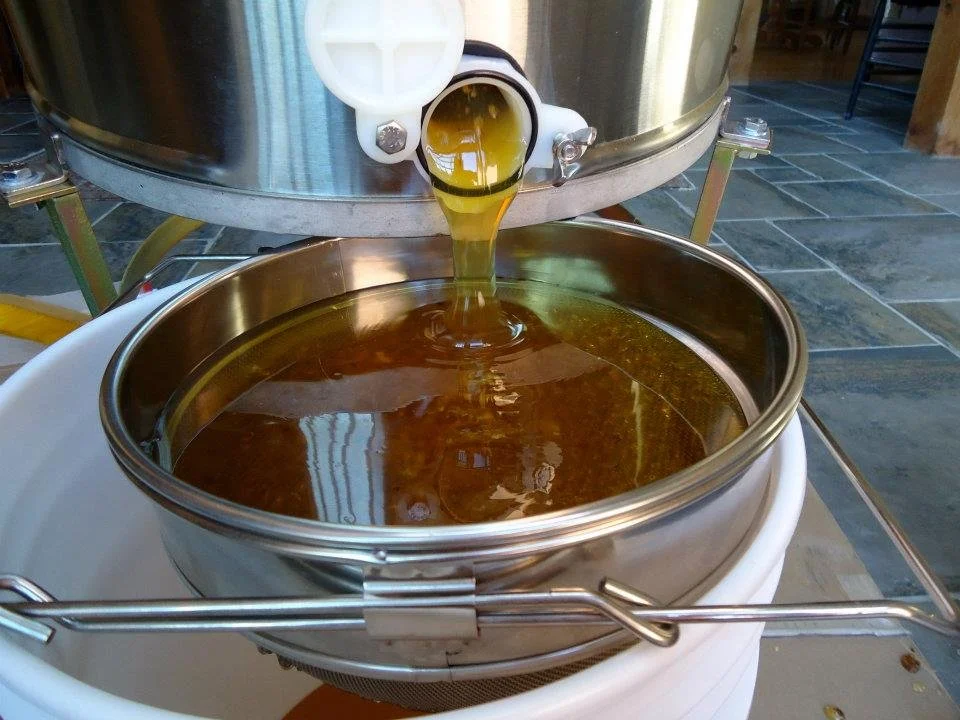
It took thousands of bees an entire summer to make this much honey — 1/12 of a teaspoon per bee.
We don’t keep bees mainly for what we can take from them. We keep them mainly for the pollination: two working hives moving pollen from flower to flower across every field here, all summer, worth more to this farm than any honey they’d make. So every fall it’s still a judgment call how much honey we take for ourselves, because taking too much is how a hive doesn’t make it to spring, and a hive that doesn’t make it to spring isn’t out there working for us come July.
The honey that we leave is what feeds the colony through the winter. Bees don’t sleep through the cold the way a bear does. The whole hive pulls into a tight ball, thousands of them pressed together, shivering their flight muscles to make heat instead of flight. The ones on the outer edge take the cold first, then push toward the center and let others hold the edge in their place, so the group survives together instead of a few staying warm at everyone else’s expense. Break the cluster apart and a single bee dies fast, alone, in weather the whole group can shrug off for months.
Next time you stir a spoonful of honey into your tea, or spread it on toast, it’s worth a second to think about what went into it: thousands of bees, each doing her own small, unglamorous part for the colony.
Who’s doing that in our own community right now, the quiet work that keeps the whole thing running, without much notice?
(We carry honey from Fahey Family Farm and Lori Mead’s LAM Farm in the store.)