
Systems of Resilience: Energy-Efficient Advances Power a Vegetable Farm
Originally published in Acres U.S.A., February 2022 (Issue #608). By Tracy Frisch.
Red Shirt Farm is a no-till micro farm in western Massachusetts that follows organic principles, practices regenerative agriculture and strives to produce nutrient-dense food. Farmer Jim Schultz spent a number of years as a young adult learning about and working in ecological agriculture before pursuing a quarter-century career as a biology teacher, coach and school administrator. He retired early to pursue his lifelong dream of farming.
The farm devotes its three 30-by-72-foot gothic high tunnels to tomatoes, peppers, cucumbers and ginger during the growing season, and to cold-tolerant greens over the winter. The controlled environment reduces disease pressure in the tomatoes, the farm’s most profitable crop, among other benefits. Two of the high tunnels have a conventional design, with a double layer of ordinary greenhouse plastic film inflated with a fan, and roll-up sides. The third high tunnel has advanced features designed to enhance energy efficiency and horticultural potential: a climate battery, thermal curtains, and a covering called SolaWrap.
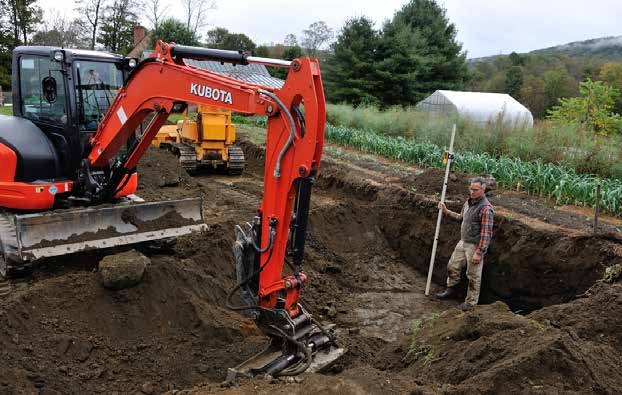
Jim Schultz oversees excavation for the climate battery beneath one of Red Shirt Farm’s high tunnels. Photo courtesy of Red Shirt Farm.
The most unique feature of the advanced high tunnel is its climate battery, sometimes called “the poor man’s geothermal.” A climate battery optimizes solar heating, can cool and dehumidify the air, and reduces fossil fuel use. Jim had looked into conventional geothermal, but the geology of his land wasn’t conducive to it. Constructing a climate battery is a big project involving heavy equipment: it must be built before the high tunnel goes up, since it requires deep excavation so that multiple levels of pipes and manifolds can be installed several feet beneath the soil surface. For the project, Red Shirt Farm contracted with EcoSystems Design, Inc., a Colorado company founded by Jerome Osentowski, author of “The Forest Garden Greenhouse,” for the engineering and design work.
They excavated four feet deep and installed interconnected 4-inch perforated drainage pipes a foot apart, running 30 feet into a central manifold. In total, the climate battery has three layers of pipe and three-quarters of a mile of drainage pipe, maximizing the amount of heat transferred from the air into the soil. In hot weather, the climate battery pulls a significant portion of that extra heat into the ground, cooling the air in the high tunnel. It retains that heat underground even as the weather cools, and gradually, through a system of fans, releases it back into the high tunnel through fall and well into winter. Without added heat, the climate battery keeps the high tunnel at 40 degrees in December. “If we drop a thermometer into one of these pipes, the soil temperature will be 65 or 70 degrees,” Jim said. “It will stay warm through January or February. We’re able to close the thermal curtain at night and conserve this heat.”
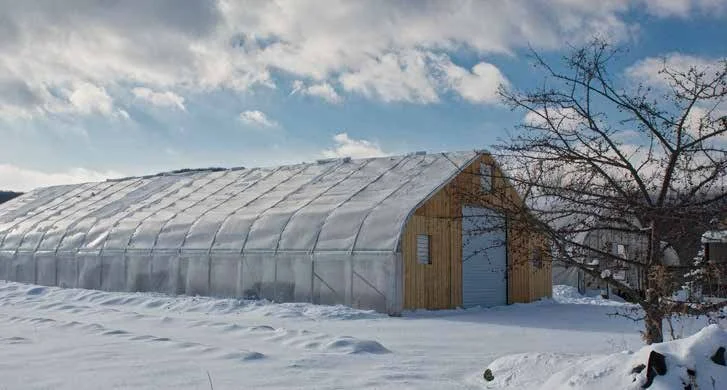
Red Shirt Farm’s advanced high tunnel, skinned with SolaWrap, in winter. Photo courtesy of Red Shirt Farm.
Jim calls thermal curtains “the most cost-effective upgrade that you can make in a high tunnel.” Common in glass greenhouses but rare in high tunnels, they’re made of a flexible, poly-type material interspersed with metallic strips that reflect infrared radiation, and can retain 60 to 90 percent of that radiation on cold winter nights, while reducing intense summer heat during the day. Jim’s curtains are suspended from the ceiling on tracks and open and close on a motorized pulley system, like a sliding venetian blind. The high tunnel’s covering, SolaWrap, is a three-layer bubble-wrap-style polyethylene film that diffuses light more evenly than standard greenhouse plastic, is rated for 83 percent light transmission, and can withstand hail, 112-mph winds and six feet of wet snow. A $10,000 grant from Berkshire Agricultural Ventures, a local nonprofit that assists area farmers with financial and technical support, helped Red Shirt Farm install the climate battery and purchase the SolaWrap. Jim figures on a 12-year payback for the advanced high tunnel’s added features, and estimates the climate battery alone prevents roughly 51 tons of CO2 emissions annually.
In the two high tunnels, Red Shirt Farm grows both heirloom and hothouse tomatoes using an intensive production system involving grafting, a “lower and lean” trellising method, and regular sap analysis for nutrient and disease management. Grafted tomato plants resist root-borne disease and can yield 30 percent more than ungrafted ones. Working with the crop consulting firm Advancing Eco Agriculture, Jim has fine-tuned the farm’s nutrient program with regular sap testing rather than waiting for disease to appear. “Since using sap analysis, we’ve seen a big change in production,” Jim said. “It was the best crop we ever had.”