
How and Why a Climate Battery Works
Originally published in Country Folks Grower, December 2, 2023. By Sonja Heyck-Merlin.
“Simply, a climate battery is a system that pushes warm, humid air around the greenhouse, using hot air that would otherwise be exhausted and using that to heat the soil underneath,” explained Jim Schultz, whose Red Shirt Farm is a small mixed vegetable operation in Lanesborough. Schultz and other vegetable growers discussed climate battery systems as part of the Hudson Valley Farming Webinar and Field Day Series on farming in a changing climate.
Climate batteries, also known as subterranean heating and cooling systems, geo-air exchangers or poor man’s geothermal, can be used for both heating and cooling. During hot days, high tunnels accumulate heat that’s typically vented passively or mechanically and wasted. In a climate battery system, that excess heat is instead forced underground through pipes, where the soil absorbs the thermal energy, and cooler, drier air is exhausted back into the tunnel. At night or during winter, the process runs in reverse: the fan draws cool air through the warm soil and the warmer air is exhausted back into the high tunnel.
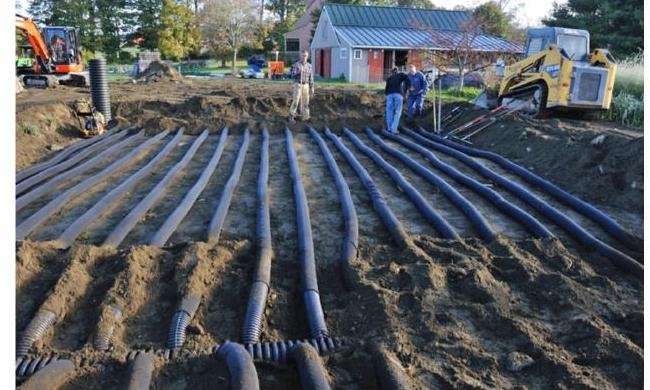
Schultz’s climate battery lies beneath a 30-by-72-foot high tunnel. Because the build involves digging a large, deep hole, he suggested probing the site beforehand to check for rocks, and cautioned that wet, clay soils aren’t suitable. “Think about what clay turns into when it’s heated. You’d get pottery around your pipes,” he said. Excavation is the first step: he hired friends with an excavator and a bulldozer to remove the topsoil and subsoil, keeping the piles separate, and dug down four feet.
Next, Schultz laid three 30-foot manifolds made of 12-inch culvert pipe, drilling three rows of holes into each about four feet apart. The climate battery has three layers of heat exchange tubing — four-inch perforated drainage pipe with a sock to keep silt out — installed in 30-foot sections and backfilled mostly by hand, since heavy equipment could crush the tubing. Using a skid steer for even weight distribution, he spread 14 inches of topsoil on top, deep enough to safely use a broadfork without puncturing the pipes below. Finally, he installed two-inch rigid foam board insulation around the perimeter, cutting each sheet to run two feet down and two feet out — the equivalent, he said, of going almost five feet straight down, saving excavation time and material.
Schultz finds the climate battery is as much an asset in summer as in winter. During the growing season he uses it for tomatoes, cucumbers and ginger, and no longer needs to roll up the high tunnel sides until 10 a.m. His crew even seeks out the climate battery tunnel on hot days for the cool air venting from the output — “it literally feels like air conditioning,” he said. “We have three identical houses. Only one is a climate battery, and hands down it’s the one that’s the most productive for us in the summer months and in the winter without any extra heat. It’s also the nicest to work in. I would say, if you can have your payback be four years or less, it’s definitely worth it.”