With Thoughtfulness, Care, and Innovation, Red Shirt Farm Thrives
Originally published in The Berkshire Edge, August 2017. By Emma Bailey Ryan.
The long driveway of Red Shirt Farm takes you away from Route 7 and over a rise onto the land of farmers Jim and Annie Schultz. Located just north of Pittsfield, it is a thoughtful, family-owned farm that holds, as Jim says, “animal welfare, the local food system and sustainability” in high esteem. The drive ends at a lovely cinnamon-colored home, surrounded by their 10-acre parcel of land. Close to the house is a small building where people pick up their weekly CSA share. Large vegetable plots and a few greenhouses prominently ring the yard until the land slopes down into field. Jim greets us wearing a broad, welcoming smile, glasses, heavy-duty khakis, and, yes, a red shirt.
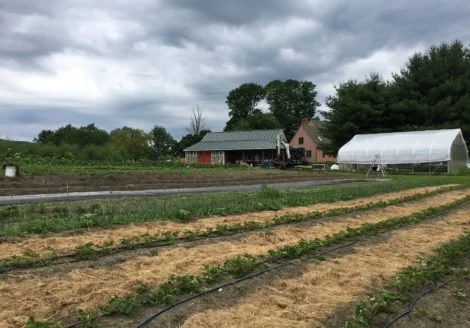
Vegetable fields, greenhouse, and packing shed at Red Shirt Farm.
Our small group from Berkshire Grown begins the tour at a partially covered plot, with kale, beans and peas dominating one side. There, Jim tells us about their conscientious philosophy of farming, methods that embody the idea that soil nutrition equals human nutrition. Cultivating areas take time, he explains, and they generally plan on three years from opening a plot “until it hits its stride.” The use of homemade compost, mulch, and cover crops all help maintain the integrity of the soil. In addition, each bed is shaped by hand. There are a few advantages to this approach. Using broad forks and other hand tools means low-till beds and less soil compaction from machinery. The soil is loosened without causing damage and, as Jim points out, many worms are spared, as well. Also, working on a “human scale” is not only better for the earth, it saves on space.
This spatial efficiency is also witnessed in the greenhouses. Jim leads us in the direction of the largest, which sits a good stone’s throw away. Through the ample open doorway we see tall, lush, densely sown tomato plants. He explains how they use the “lower and lean” method, which allows the tomatoes to continue growing and producing without reaching heights that make harvesting difficult. Each plant is trellised on a reel and string system, so that as they grow more string can be let out for them. Tomatoes are not the only crop enjoying efficient farming in the greenhouse — the eggplant utilize a reel and string system, too, and the cucumbers are grown using the “umbrella method.” One vine grows upward and then the plant is pruned so that it’s “a cascade of cucumbers all the way down.”
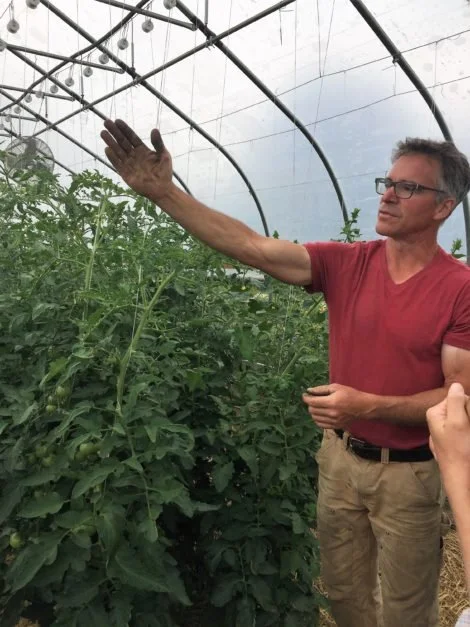
Jim Schultz showing his tomato growing trellis system.
Before moving on, he emphasizes another important aspect of agriculture at Red Shirt Farm. Gesturing toward a row of plants closest to the nursery wall, he says, “We need to educate people about the use of the word organic.” Instead of spraying herbicides or pesticides of even the organic variety, the farmers hand-pick potato beetles and other bugs from vegetation. Many, many hours a week are spent taking personal care of the plants, from pest management to pruning and beyond. Using innovative ideas and a “back to the earth” mentality, they maximize space and maintain the integrity of their soil and vegetables.
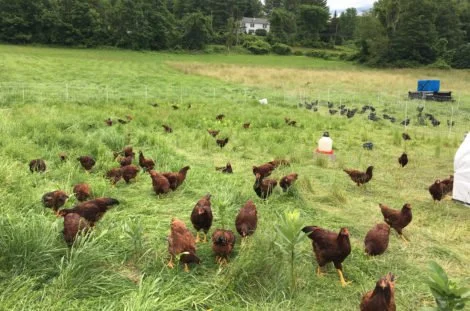
Chickens on pasture at Red Shirt Farm.
This attention to care extends to the farm’s heritage breed chickens, turkeys, pigs and bees. Heading to visit the chickens, we leave the greenhouse and walk past a large garden that boasts beautiful rows of lettuces and other vegetables. The two breeds, Buckeyes and Australorps, are each pastured in their own large runs. The mobile “coops” house food and perches and allow the birds to be moved about the field frequently for fresh grazing. Similarly, the pigs are housed in a “wagon wheel” type of enclosure, so that they can be offered new pasture while their previous section is regenerated. “We’re trying to bring flavor back,” Jim says, explaining why the farm raises heritage breeds — older breeds of livestock that have largely fallen out of favor in the age of industrial agriculture. They take longer, and are more expensive, to raise, but they produce more flavorful meat and certain breeds are a better fit for our New England landscape.
So, what does the future hold? Jim and Annie are interested in getting solar panels installed on the farm. They are also recipients of a Local Farmer award through the Harold Grinspoon Foundation, offered to Berkshire Grown and CISA (Community Involved in Sustaining Agriculture) members. They hope to use the funds to install radiant heating in the large greenhouse — the base is already insulated, and radiant heat is the next step toward growing through the winter, as well as a more efficient way to warm their chicken brooders.
Red Shirt Farm products are available through their CSA and at the Dalton Public Market.
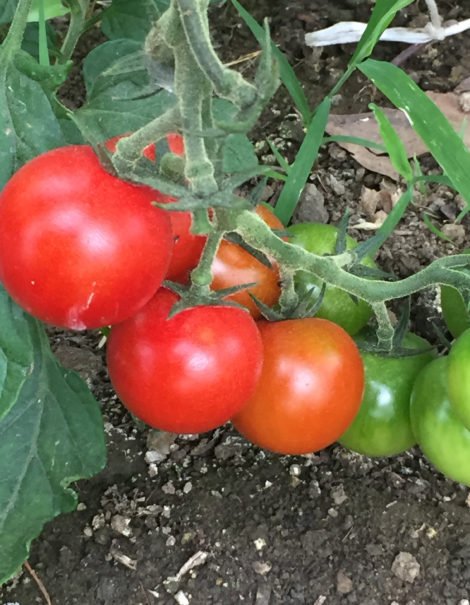
Heirloom tomatoes at Red Shirt Farm.