Food Visionaries: Berkshire Group’s Push for Healthy Food for All
Originally published in Berkshire Magazine (TownVibe Berkshire), October 2017. By Anastasia Stanmeyer.
Farmer Jim Schultz, food distributor Nick Martinelli, and Berkshire Agriculture Ventures executive director Cynthia Pansing encapsulate what the national food movement strives to be. Regionalized. The business of locally grown food has many implications — protecting lands, creating jobs, improving local economy, becoming more socially conscious, being healthier. A New England Food Vision report holds that this region can produce 50 percent of the food it consumes by doubling productive farm areas.
Striving toward that reality, organizations like Berkshire Agricultural Ventures (BAV) in Great Barrington, once a program of Berkshire Grown and the Carrot Project, are addressing an array of food security issues, engendering support for entrepreneurs and farms through technical help, assisting in grant writing, and giving direct financial support. In 2016–17, BAV invested $150,000 in the form of loans, startup capital, and land acquisition, and provided $95,000 worth of technical assistance. If a farmer or entrepreneur has a vision, BAV will find someone to work with them to develop a business plan or enterprise, or expand and improve what they already have.
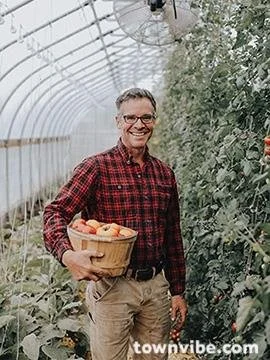
Jim Schultz at Red Shirt Farm in Lanesborough. Photo by Matt Petricone.
Take Schultz, with Red Shirt Farm in Lanesborough, who believes that his heritage-breed birds and pigs can feed our Berkshire population and preserve and strengthen the farming culture here, “providing employment for local people because it’s more labor intensive,” he says. Farms like his, which is also a CSA (Community Supported Agriculture), now accept SNAP and HIP benefits and do the transactions with a reader on an iPhone. A half-share of his produce is $425 for 20 weeks — cheaper than shopping at Guido’s or buying organic.
“The biggest challenge is educating the consumer and changing the mindset,” Schultz says. “They are so accustomed to dirt-cheap food and so seduced by that, the cycle of ill health and people buying bad food goes on and on.”
Historically a strong agricultural region, the Berkshires has seen a decrease in agricultural land as it transitioned to a manufacturing and cultural-asset base. Three percent of all Massachusetts farms have annual gross sales of $500,000 and above, while almost 70 percent gross less than $10,000. Small and medium-sized farm and food businesses are often constrained in their ability to grow and scale up because they lack technical resources, capital, infrastructure, and/or land. By supporting farms and food businesses, BAV strives to open new markets, increase revenues, and make healthy food accessible to all.
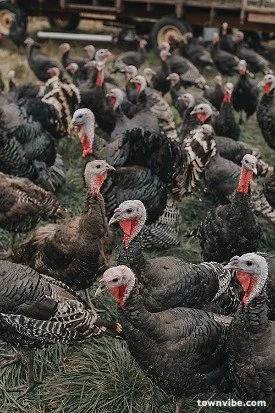
Heritage breed turkeys at Red Shirt Farm. Photo by Matt Petricone.
A large number of animals were once raised here, but the young animals were sent to feed lots in the Midwest, and with them went our ability to produce our own local meat. That’s changing. More people are raising a small number of cattle and selling them to local butcheries and restaurants. The biggest challenge is that no slaughterhouses are found in the region, so farmers must book slots at locations farther away. Some farms are doing it on their own — Red Shirt Farm raises heritage chickens and turkeys and processes them in its mobile unit. They are sold whole because they can’t be parted unless it’s in a USDA-certified plant.
BAV has lent its assistance to Schultz, helping him with marketing and business development, especially for his heritage breeds. Grants from the USDA’s Natural Resources Conservation Service have allowed him to pay for two high tunnels, and BAV has allocated money for technical assistance and a climate battery — a subterranean heating and cooling system — for the second tunnel. “Farmers love to farm but don’t necessarily love to market,” says Schultz. “BAV is that missing link.”